
Major General Amir Hatami, commander-in-chief of the Iranian Army, condemned the attack on the vessel, one of the country's newest warships, which occurred while it was returning from a military exercise.

The US torpedo attack on the Iranian warship IRIS Dena in international waters was a lawful act of war between belligerents, not a diplomatic or strategic embarrassment for India, asserts Vice Admiral Biswajit Dasgupta (retd).
Following the death of Iranian sailors in the Indian Ocean, Iran's navy has threatened 'deadly retaliation,' accusing the US of attacking its warship off the coast of Sri Lanka, escalating tensions in the region.

At least 22 Iranian sailors from the IRIS Dena, which sank after being torpedoed, have been discharged from a Sri Lankan hospital. Another 10 remain under treatment, while arrangements are being made to repatriate the bodies of 84 sailors recovered after the incident.

The vessel sank on March 4, 2026, approximately 20 nautical miles west of Galle, after reportedly being struck by a torpedo from a United States submarine.

Over 230 Iranian sailors were repatriated from Sri Lanka after incidents involving two naval vessels, including a reported US submarine attack and an engine failure.

India granted emergency docking to an Iranian ship, IRIS Lavan, in Kochi due to technical issues, accommodating its crew amidst regional naval activity and tensions.
Sri Lanka will repatriate the bodies of Iranian sailors killed on the IRIS Dena, which was reportedly sunk by a US submarine. The government is also addressing potential impacts on food security and fuel supplies due to the war situation.

Top government sources in India have dismissed claims that the Indian Navy provided intelligence to the US regarding an Iranian frigate that was sunk by a US submarine.
Sri Lanka has completed the post-mortem examination of Iranian sailors recovered from the frigate IRIS Dena, which allegedly sank after a US submarine attack. Eighty of the 84 bodies have been identified by survivors, and an opposition protest was held against military aggression against Iran.
Amid rising tensions, Iran threatens retaliation after the United States confirms sinking its warship, IRIS Dena, in international waters, escalating conflict in the region.

Amidst escalating regional tensions, Sri Lanka is carefully considering its response after a second Iranian ship requested entry into its waters following a reported US submarine attack on an Iranian frigate near Galle.

India has expressed condolences over the death of Iran's Supreme Leader Ayatollah Ali Khamenei following a joint US-Israel strike, amidst rising tensions in West Asia and criticism over the sinking of an Iranian warship.

Amid escalating tensions, Iranian Deputy Foreign Minister Saeed Khatibzadeh declares Iran's unwavering commitment to a 'heroic nationalist defence' against perceived American and Israeli aggression, vowing to resist what he calls an 'invasion' to the very end.

Sri Lanka's President Anura Kumara Dissanayake announced that the country refused permission for the US to land two warplanes at Mattala International Airport, citing a commitment to neutrality amidst rising tensions in the Middle East.

External Affairs Minister S Jaishankar affirms India's self-determined and 'unstoppable' rise, emphasising the nation's strategic growth and role in the Indian Ocean region amid evolving global dynamics.

The Sri Lanka Navy rescued 32 Iranian sailors from a sinking naval ship off the southern coast, while also recovering several bodies. The incident occurred outside Sri Lankan waters but within its search and rescue zone.
Sri Lanka has allowed a second Iranian ship, IRINS Bushehr, to dock at Trincomalee port after it reported engine failure, following the sinking of an Iranian frigate. The move comes amidst heightened regional tensions and a joint US-Israeli attack on Iran.
Tensions escalated dramatically on March 5, 2026, as the United States and Israel launched coordinated strikes on Iran, triggering retaliatory explosions across Tehran, Sanandaj, and beyond.

US Special Representative Sergio Gor met with Sri Lankan President Anura Kumara Dissanayake to discuss strengthening bilateral relations and Sri Lanka's stance on the Middle East crisis. The visit occurs amidst regional tensions and US efforts to secure trade routes in the Indo-Pacific.
It is for the first time that a senior minister has said that Iran requested permission for docking three of its ships in Indian ports.
Sri Lanka is deliberating appropriate action after a second Iranian ship sought entry to its territorial waters, following an attack on an Iranian frigate near the island nation. The government is focused on safeguarding lives and regional peace.

'Torpedoes travel at more than 100 kilometres per hour, about 50-60 knots.' 'It must have been a matter of a few minutes before it detonated under the Iranian ship.' 'The Iranian ship would have probably got three, four minutes and wouldn't have known till they actually heard the whirr of the torpedo.'
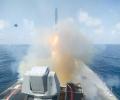
'India was not obliged to protect the Iranian ship.' 'Once the Iranian ship left Indian waters, she was on her own.' 'Guilt tripping India is wrong.'

A lesson for India is to clearly define objectives beforehand, so that the adversary or other parties do not attempt to mitigate them midway.
At least 101 people are missing and 78 are injured after a suspected submarine attack on an Iranian naval ship off Sri Lanka's southern coast on Wednesday, Reuters quoted sources in Sri Lanka's Navy and defence ministry as saying.

Let us start with ourselves. If we can reduce our LPG consumption by half, the problem is solved. Reduce wastage. Alter eating styles. Diversify methods of food preparation, suggests Vice Admiral Biswajit Dasgupta (retd).

AICC President Mallikarjun Kharge criticised Prime Minister Narendra Modi's relationship with US President Donald Trump, alleging that Modi is acting as Trump's 'slave' and jeopardising India's interests on trade, oil and foreign policy.

For weeks, the war skirted the edge of catastrophe without tipping over. Missiles flew, there was much destruction, commanders were assassinated, cities across the Gulf and even in Israel struggled to absorb the shock. But one line held: Energy infrastructure, the arteries of the global economy, remained largely untouched. That is no longer true. Prem Panicker continues his must read daily blog on the Gulf War.

Iran is fighting a different war: Older, slower, and in some ways more dangerous. Iran doesn't need to shoot down an F/A-18. It only needs to make the Strait of Hormuz feel dangerous long enough for insurance markets, shipping companies, and oil futures traders to do the rest. Prem Panicker continues his must-read daily blog on the war in the Middle East.

Taking Kharg would give the US control over virtually all of Iran's oil exports and thus provide significant leverage, notes Prem Panicker in his must read daily blog on the Gulf War. It would also put American troops within range of Iran's remaining missiles, drones, and artillery on a piece of real estate that is just eight square miles in size, and just 15 miles from the Iranian mainland.

The question is no longer whether the war will expand. It has. The next few days will tell us whether the war stabilises around Hormuz or whether the Strait itself becomes the trigger for a far larger rupture. What to watch for over the next 48 hours is simple: Any move by the US toward direct naval control of the Strait; any credible Iranian attempt to disrupt or mine shipping lanes and, critically, whether energy infrastructure in the Gulf continues to be targeted.If those lines are crossed in tandem, the war will no longer be containable within the region.

When everyone has footage and no one can verify it, the loudest voice wins, notes Prem Panicker who begins a daily blog on the War in the Middle East.
